
Buying pre-owned with confidence
The pre-owned market is where the most interesting watches live — and where the most expensive mistakes are made. Seven checks that separate the two.
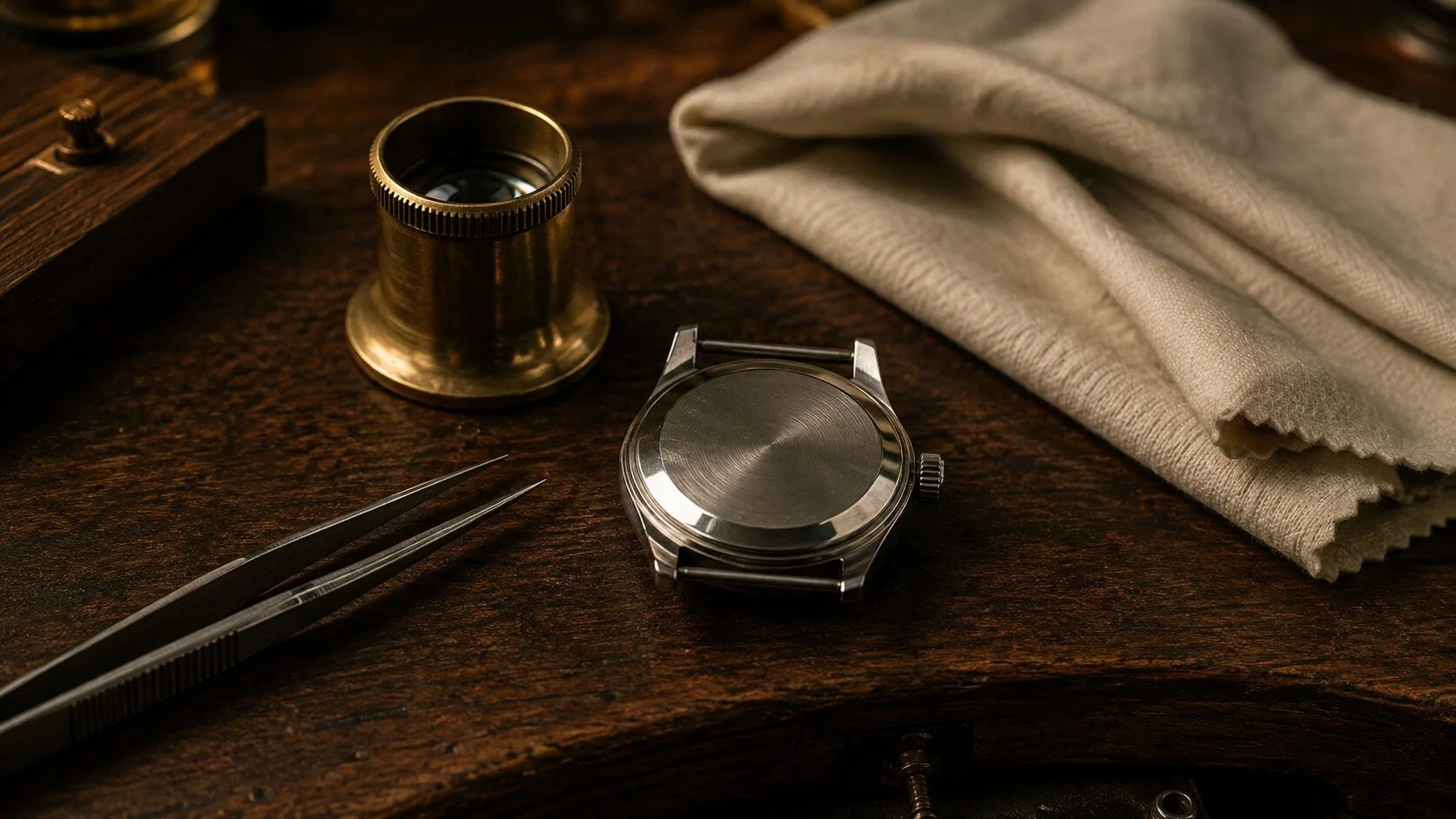
Almost every watch worth owning was made before you started looking for it. The pre-owned market is not a discount aisle; it is the whole of watchmaking history, minus whatever is currently in production. It is also where a convincing forgery costs the same as the real thing.
These are the checks we run on every piece before it reaches our display case. You can run most of them yourself.
1. The papers matter less than you think
A full set — box, warranty card, receipts — adds meaningfully to resale value, and it is regularly forged. Papers are supporting evidence, never proof. A watch that is correct in every physical detail with no papers is a far better buy than a suspect watch with a full set.
2. Match the serial to the reference
Every maker has a serial range corresponding to a production period. A case whose serial says 1998 should not contain a movement introduced in 2004, and should not wear a dial variant discontinued in 1994. Mismatches are not always fraud — service departments swapped parts for decades — but each one should have an explanation.
3. Look for polishing
Over-polishing is the most common and least reversible damage in the vintage market. Case edges should be crisp; the transition from brushed top surface to polished flank should be a hard line, not a gentle blur. Lugs should have flat tops and defined chamfers. A soft, rounded, glossy case has lost metal permanently, and with it much of its value.
Scratches are history. Rounded lugs are damage. Learn the difference and you will avoid most bad buys.
4. Inspect the dial in raking light
Hold the watch so light crosses the dial at a low angle. Refinished dials show soft, slightly blurred printing and lume plots that sit oddly in their frames. Original dials age — that is fine, and often desirable — but they age evenly. Patchy discolouration around the edge often means moisture has been inside.
5. Listen and feel
Wind a hand-wound movement slowly. It should feel smooth and progressive, with a definite stop. Grinding, slipping or a gritty texture means wear. On an automatic, rotate the watch gently — the rotor should spin freely and quietly. A rattle or a scrape is a rotor bearing on its way out.
6. Ask when it was last serviced
“Recently serviced” without an invoice means nothing. Ask for the date, the watchmaker and what was done. A watch that has run twelve years without a service is not a bargain at any price; the lubricants have long since dried and the pivots have been running on metal.
7. Buy the seller
Ultimately every check above can be defeated by a sufficiently good forger. What cannot be faked is a seller who will take the watch back. Our own position is simple: every pre-owned piece we sell is inspected and timed by our watchmakers, carries a 24-month warranty, and can be returned within fourteen days if it is not what you hoped. Ask for the same anywhere else you buy.
Continue reading
The quiet return of the 36 mm case
14 July 2026
Your first mechanical watch: a field guide
28 July 2026
Reading a dial: a short vocabulary
26 May 2026