
Your first mechanical watch: a field guide
A first mechanical watch is rarely a technical decision. It is a decision about how you want to mark time — and the specification should follow from that, not lead it.

Most people arrive at their first mechanical watch by way of a feeling rather than a specification sheet. They notice a dial across a table, or inherit something from a grandfather, or simply tire of a screen telling them the hour. That instinct is worth trusting. The specification should serve it, not overrule it.
Still, a handful of decisions will shape how much you wear the watch over the next decade. These are the ones we walk clients through in the salon, in roughly this order.
Start with the wrist, not the catalogue
Case diameter is the single most common regret. A 44 mm diver looks decisive in a photograph and overbearing on a 16 cm wrist. Measure yours with a tape before you shop. As a rough guide, wrists under 16 cm sit best with 36–39 mm cases, 16–18 cm with 38–41 mm, and above that you have genuine latitude.
Lug-to-lug length matters more than diameter, though it is rarely advertised. A 40 mm case with long, flat lugs will overhang a wrist that happily carries a 42 mm case with steeply curved ones. This is why we ask you to try three references before discussing any of them seriously.
Automatic or hand-wound
An automatic winds itself from the motion of your arm and will run indefinitely if worn daily. A hand-wound movement asks for twenty seconds of your attention each morning. Collectors are split, and both camps are right: one is convenience, the other is ritual.
If the watch will be one of several in rotation, a hand-wound piece is less frustrating than an automatic that is permanently stopped. If it will be worn every day, an automatic disappears into the routine entirely.
The best first watch is the one you stop noticing you are wearing — and then notice again, gladly, six months later.
Accuracy, honestly
A good mechanical movement keeps time to within roughly five to ten seconds a day. A certified chronometer tightens that to −4/+6 seconds. A twenty-dollar quartz watch beats both and always will. You are not buying a mechanical watch for accuracy; you are buying it for the fact that a few hundred parts, assembled by hand, keep approximate faith with the rotation of the earth.
What you should insist on is consistency. A watch that gains four seconds a day, every day, is healthy and easily corrected. One that gains four seconds on Monday and loses fifteen on Thursday is asking for a service.
Water resistance, translated
The figures on a caseback are pressure-test ratings, not swimming instructions. In practice: 30 m survives rain and handwashing. 50 m is fine for a shower you did not plan. 100 m swims. 200 m and above dives. Whatever the rating, the gaskets are consumables — they should be replaced at every service, and a watch that has not been pressure-tested in five years should be treated as unrated.
Budget for the second decade
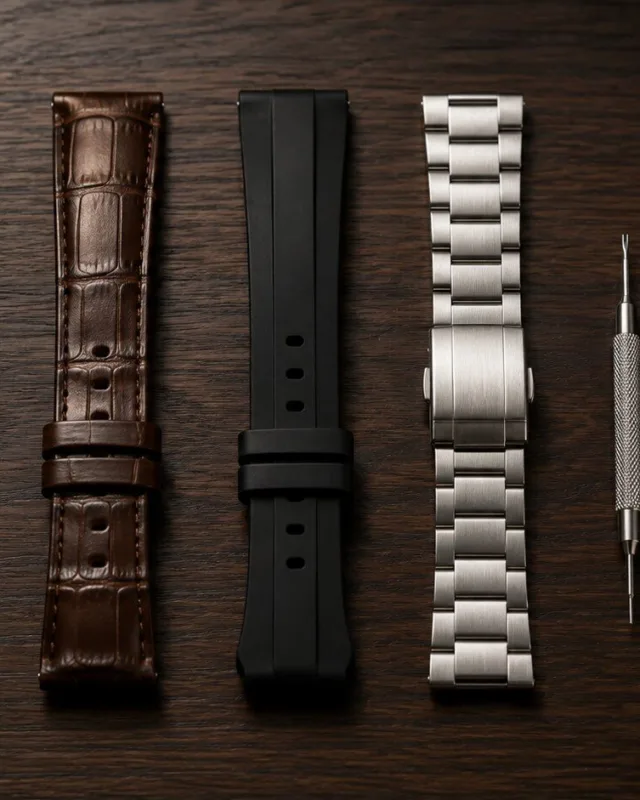
A mechanical watch is the rare purchase with a running cost. Plan on a full service every five to seven years, at roughly eight to twelve per cent of the watch’s value. Straps wear out sooner. Factoring this in at the start is what separates an heirloom from a drawer ornament.
Bring your questions to the salon. There is no purchase we would rather slow down than a first one.
Continue reading
Buying pre-owned with confidence
12 May 2026
What “in-house movement” actually tells you
30 June 2026