
Reading a dial: a short vocabulary
Sunray, guilloché, applied, printed, lumed, lacquered — the words that describe how a dial is made, and what each one costs to produce.
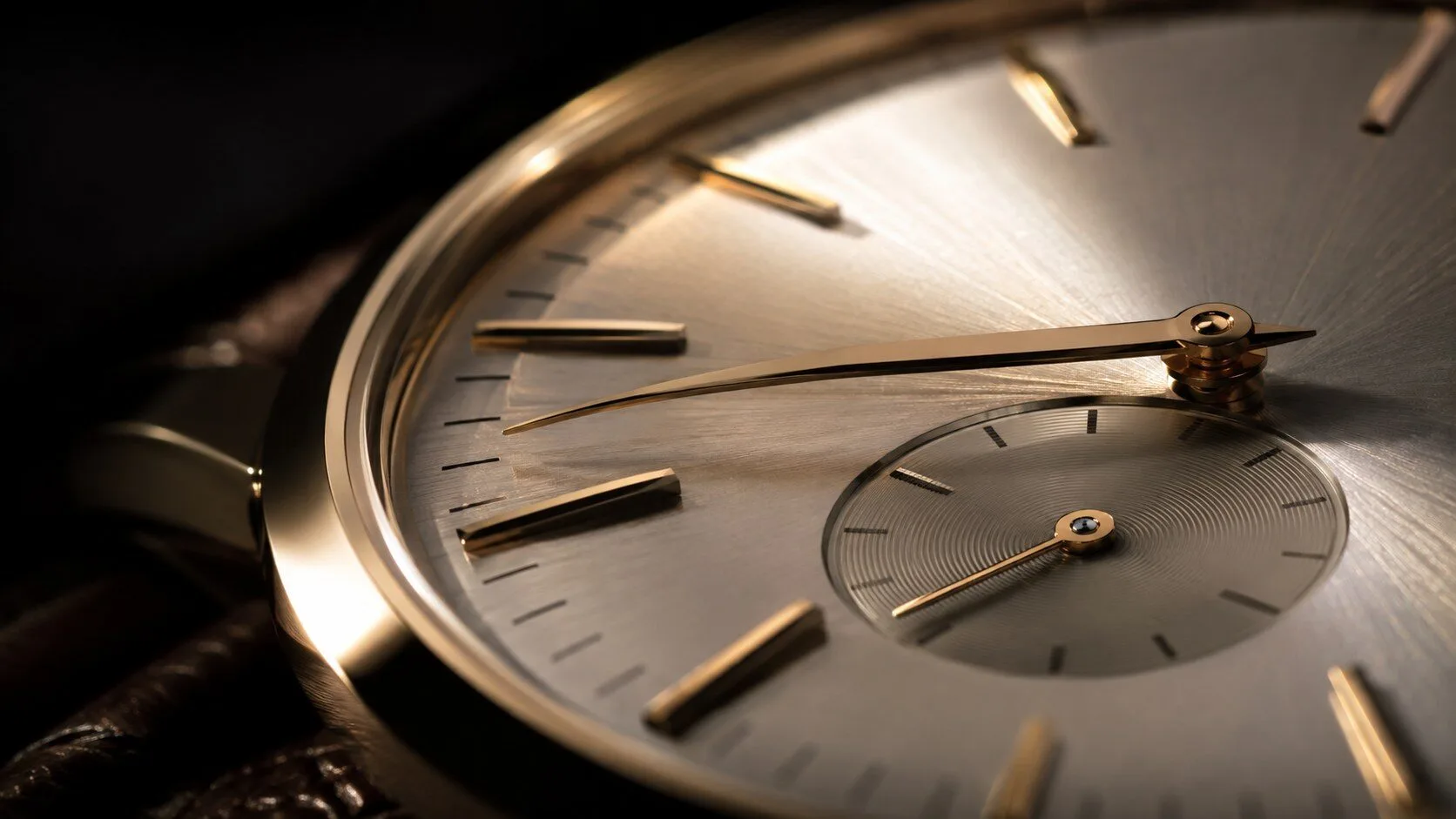
The dial is the part of a watch you will look at several thousand times a year, and the part where cost-cutting shows first. A short vocabulary makes it much easier to see what you are being sold.
Finishes
Sunray (or sunburst) dials are brushed radially from the centre, so light sweeps around the dial as the wrist turns. It is the most common premium finish and, done well, the most alive.
Guilloché is a geometric pattern cut into the metal. Genuine hand-engine-turning on a rose engine is rare and expensive; most “guilloché” today is stamped, which is a perfectly honest process producing a shallower, softer pattern. Under a loupe the difference is unmistakable — cut lines have crisp walls and a faint tool signature, stamped ones have rounded shoulders.
Lacquered dials build depth through many thin coats, then polish flat. The best are almost liquid. Enamel — grand feu in particular — is fired at over 800 °C, several times, with a meaningful failure rate at each firing. It is why an enamel dial adds so much to the price, and why it will look identical in eighty years.
Markers and hands
Printed indices sit flat on the dial. Applied indices are separate metal pieces pinned or glued into holes, catching light along their facets and casting small shadows. Applied markers are the clearest single indicator of a considered dial; they require the dial to be drilled precisely and each marker set by hand.
Look at a dial from twenty degrees off-axis. Printed dials go flat. Applied dials come alive.
Handsets follow the same logic. A stamped hand is uniform in thickness; a good one is faceted along its length, polished on the facets and brushed or blued on top, so it reads dark against a light dial from one angle and bright from another. Blued steel hands — heated rather than painted — shift from grey to violet-blue as light changes.
Luminous material
Modern watches use Super-LumiNova or a licensed equivalent: a strontium-aluminate pigment that charges in light and glows for several hours. It does not decay and is entirely inert. Older watches — pre-1960s — may carry radium, which is genuinely radioactive and should never have its dial disturbed; between roughly 1960 and 1998 you will find tritium, which is mildly radioactive, sealed, and now largely faded to a warm cream that collectors prize.
The quality tell on lume is the edges. Well-applied lume sits level with the marker and has a clean boundary; rushed application pools, shrinks and leaves a meniscus.
Text
Finally, count the lines of text. A dial carrying six lines is usually compensating for something. The most confident dials in watchmaking say the maker’s name, perhaps the model, and nothing else at all.
Continue reading
Your first mechanical watch: a field guide
28 July 2026
The quiet return of the 36 mm case
14 July 2026