
Leather, rubber, steel: choosing a strap for Tashkent
Forty-degree summers and sub-zero winters are hard on a watch strap. A short, practical guide to what survives an Uzbek year — and what to keep for the good months.
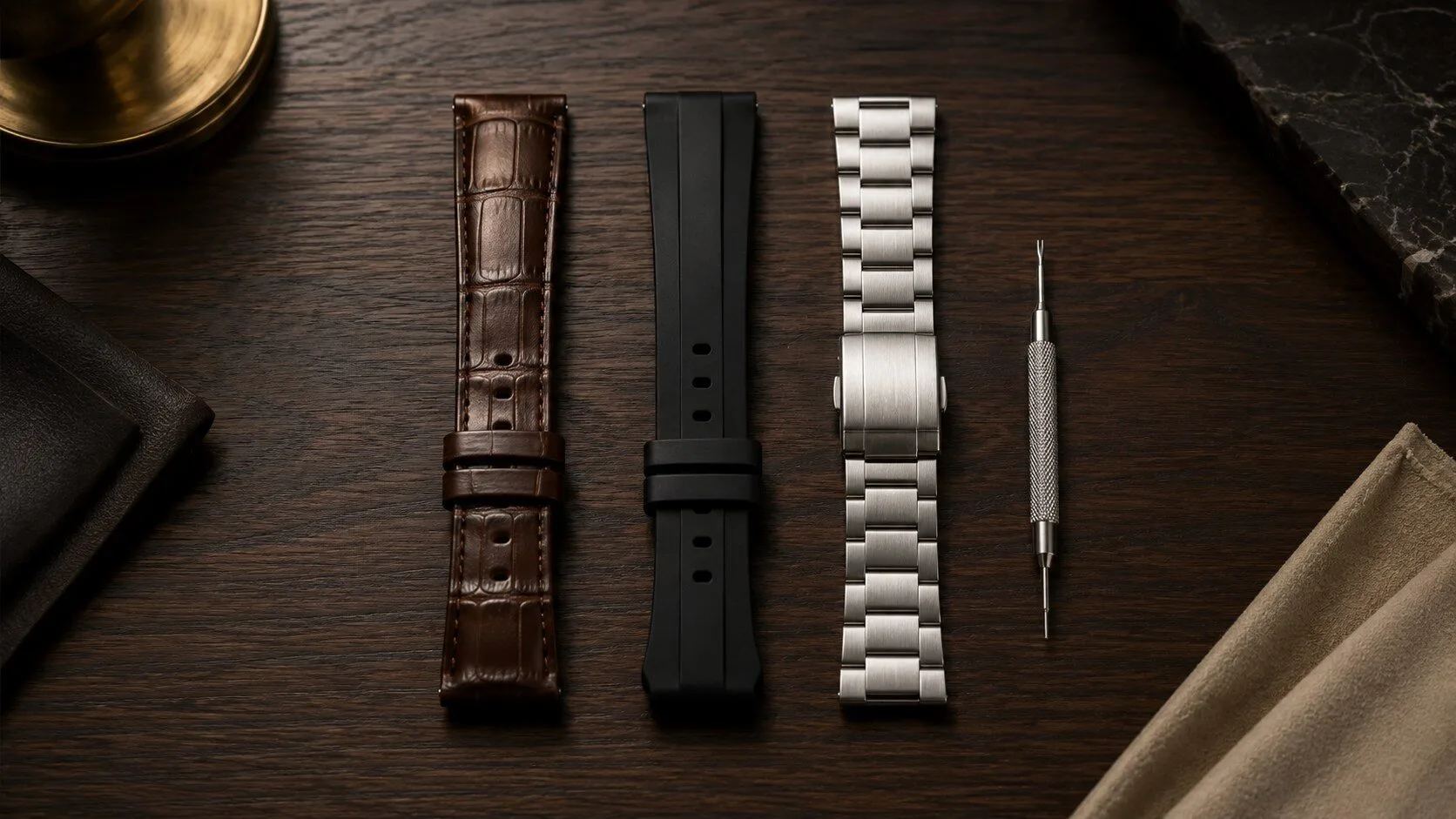
Tashkent asks a great deal of a watch strap. July regularly clears 38 °C with the kind of dry heat that stiffens leather; January drops below freezing and makes an unlined rubber strap feel like a rod. A strap chosen for a temperate European city will not last two years here.
Leather: beautiful, seasonal
Calf and alligator remain the most elegant option and the least tolerant. Perspiration is the enemy — it soaks into the underside, dries, and stiffens the fibres until the strap cracks at the fold. Leather also darkens unevenly where it sits against the skin.
Our advice is straightforward: wear leather from October to May, and keep a second strap for the summer. If you do wear it in the heat, wipe the underside dry each evening with a soft cloth and let it breathe off the wrist overnight rather than storing it in a closed box. A lined strap with a rubber or nubuck backing will roughly double its working life.
Rubber and FKM: the summer answer
Modern fluoroelastomer straps are a different material from the plasticky rubber of twenty years ago. They do not perish in ultraviolet light, they shrug off sweat and chlorine, and they can be rinsed under a tap. For a Tashkent summer they are the correct choice on almost any sports watch.
The one caveat is cold. Cheap rubber stiffens badly below zero; good FKM stays supple to about −20 °C. If a strap feels like a garden hose in winter, it is the former.
Two straps and a spring-bar tool will do more for how often you wear a watch than almost anything you can buy for it.
Steel: the year-round default
A well-made bracelet is indifferent to weather, which is why it remains the default for a one-watch collection. The trade-offs are weight and heat conduction — steel is cold on a January morning and holds warmth in August — and the fact that a poorly finished bracelet will pull arm hair for its entire life.
Look for solid end links, screwed rather than pinned links, and a clasp with micro-adjustment. That last feature matters more in this climate than anywhere: wrists swell measurably in summer heat, and a bracelet sized in December will be tight in July. Two or three positions of on-the-fly adjustment solve the problem permanently.
Textile, for what it is worth
A well-woven NATO or perlon strap is cheap, washable and genuinely comfortable in heat. It is also the only strap type that will hold the watch on your wrist if a spring bar fails. It suits a tool watch and looks out of place on a dress piece — but for a weekend in the Chimgan mountains, nothing is more practical.
We change straps free of charge for any watch bought from us, for as long as you own it. Bring it in and we will fit it while you wait.
Continue reading
Your first mechanical watch: a field guide
28 July 2026
What “in-house movement” actually tells you
30 June 2026
Buying pre-owned with confidence
12 May 2026